
File:Roman Empire map.ogv
Animated overview of Roman territorial history from the Republic until the fall of the Byzantine Empire in 1453, representing the full scope of the timeline
Roman Empire
This timeline covers the history of the Roman Empire from its origins in the Roman Republic through the fall of the Western Empire in 476 AD and the eventual fall of the Eastern (Byzantine) Empire in 1453. It encompasses major political, military, and cultural events that shaped one of history's most influential civilizations.
Source: Wikipedia5th Century BCE
Founding of the Roman Republic
Rome began expanding shortly after the founding of the Roman Republic in the 6th century BC. The Republic was governed by annually elected magistrates, including Roman consuls, in conjunction with the Senate. It was not a nation-state in the modern sense but a network of self-ruled towns and provinces administered by military commanders.
3rd Century BCE
Rome Expands Beyond the Italian Peninsula
Rome began expanding outside the Italian Peninsula in the 3rd century BC, growing from a regional power into a Mediterranean empire. This expansion was driven by military conquest and the incorporation of conquered peoples into the Roman system. The Republic organized conquered Italian communities to generate vast reservoirs of manpower for its army.
1st Century BCE
Rome Controls Most of the Mediterranean
By 100 BC, the city of Rome had expanded its rule from the Italian peninsula to most of the Mediterranean and beyond. However, this period was also marked by severe destabilization through civil wars and political conflicts. The Republic's success in conquest paradoxically sowed the seeds of its own transformation.
Assassination of Julius Caesar
In 44 BC, Julius Caesar was briefly perpetual dictator before being assassinated by a faction that opposed his concentration of power. This event triggered a new round of civil wars and political upheaval that would ultimately transform the Roman Republic into an empire. The assassins were driven from Rome and defeated at the Battle of Philippi in 42 BC.
Battle of Philippi
The faction that assassinated Julius Caesar was driven from Rome and defeated at the Battle of Philippi in 42 BC by Mark Antony and Caesar's adopted son Octavian. This victory consolidated power in the hands of the Second Triumvirate and set the stage for the eventual conflict between Antony and Octavian. The battle effectively ended the Republican cause.
Battle of Actium
Octavian's forces defeated those of Mark Antony and Cleopatra at the Battle of Actium in 31 BC, ending the last major challenge to Octavian's supremacy. This naval battle off the coast of Greece was the decisive confrontation of the Roman civil wars. The subsequent conquest of the Ptolemaic Kingdom in Egypt followed, making Octavian the undisputed master of the Roman world.
Augustus Establishes the Principate
In 27 BC, the Roman Senate granted Octavian the title Augustus ('venerated') and made him princeps ('foremost') with proconsular imperium, marking the beginning of the Principate and the first epoch of Roman imperial history. Although the republic stood in name, Augustus had all meaningful authority. This event is traditionally considered the founding of the Roman Empire.

File:Augustus of Prima Porta (inv. 2290).jpg
Augustus of Prima Porta, the first Roman Emperor
Augustus Establishes the Cursus Publicus
Augustus established the cursus publicus, the state mail and transport service, which relied on relay stations located along Roman roads every seven to twelve Roman miles. This infrastructure supported imperial administration and communication across the vast empire. Communities paid in-kind taxes that included the provision of personnel, animals, or vehicles for this service.

File:TabulaPeutingeriana Roma.jpg
The Tabula Peutingeriana, an itinerarium often assumed to be based on the Roman cursus publicus
Lex Fufia Caninia Limits Slave Manumission
In 2 BC, a law known as the Lex Fufia Caninia was passed that limited the number of slaves an owner was allowed to free in his will. This legislation reflected Augustus's concern about the rapid growth of the freedman class and its social implications. Manumission had become frequent enough that this legal restriction was deemed necessary.
1st Century
Battle of the Teutoburg Forest
In 9 AD, Germanic tribes wiped out three Roman legions in the Battle of the Teutoburg Forest, one of Rome's most catastrophic military defeats. As a result, the number of legions was increased from 25 to around 30. This battle effectively halted Roman expansion into Germania and established the Rhine as the northeastern frontier of the empire.
Death of Augustus and Succession of Tiberius
Upon Augustus's death, Tiberius succeeded him as the new de facto monarch, establishing the principle of dynastic succession in the Roman Empire. During his 40-year rule, Augustus had created a new constitutional order that made this transition possible. The Julio-Claudian dynasty would last for four more emperors after Augustus.
Year of the Four Emperors
In 69 AD, the Julio-Claudian dynasty yielded to the strife-torn Year of the Four Emperors, a period of civil war and political instability. From this conflict, Vespasian emerged as the victor and became the founder of the brief Flavian dynasty. This year demonstrated the fragility of imperial succession and the power of the military in determining Rome's rulers.
Siege of Jerusalem and Destruction of the Second Temple
The siege of Jerusalem in 70 AD led to the sacking of the Second Temple and the dispersal of Jewish political power, known as the Jewish diaspora. This event was the culmination of the Jewish-Roman wars, which resulted from both political and religious conflicts. The destruction of the Temple was a defining moment in Jewish history and transformed Judaism permanently.
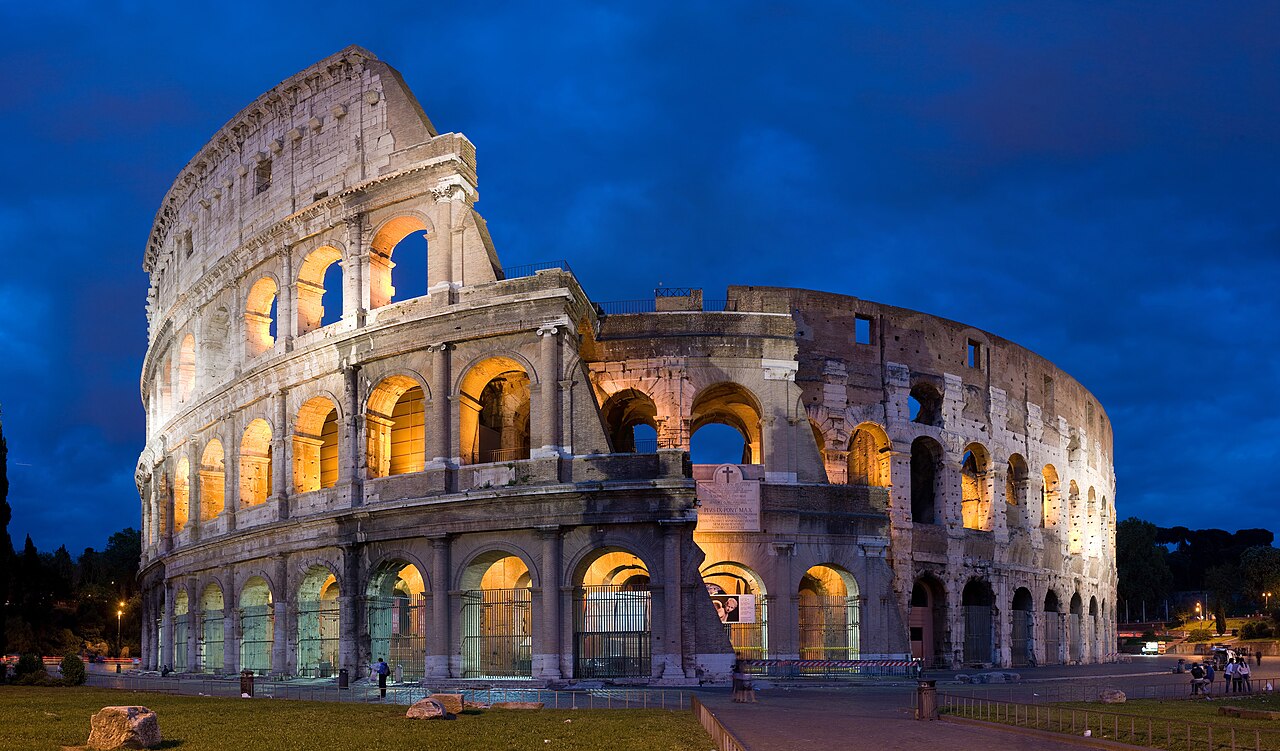
Opening of the Colosseum by Titus
To mark the opening of the Colosseum (Flavian Amphitheatre), Emperor Titus presented 100 days of arena events, with 3,000 gladiators competing on a single day. The Colosseum became the regular arena for blood sports in Rome and a symbol of Roman power and entertainment culture. Roman fascination with gladiators is indicated by how widely they are depicted on mosaics, wall paintings, lamps, and in graffiti.
File:Colosseum in Rome, Italy - April 2007.jpg
The Flavian Amphitheatre, more commonly known as the Colosseum
2nd Century
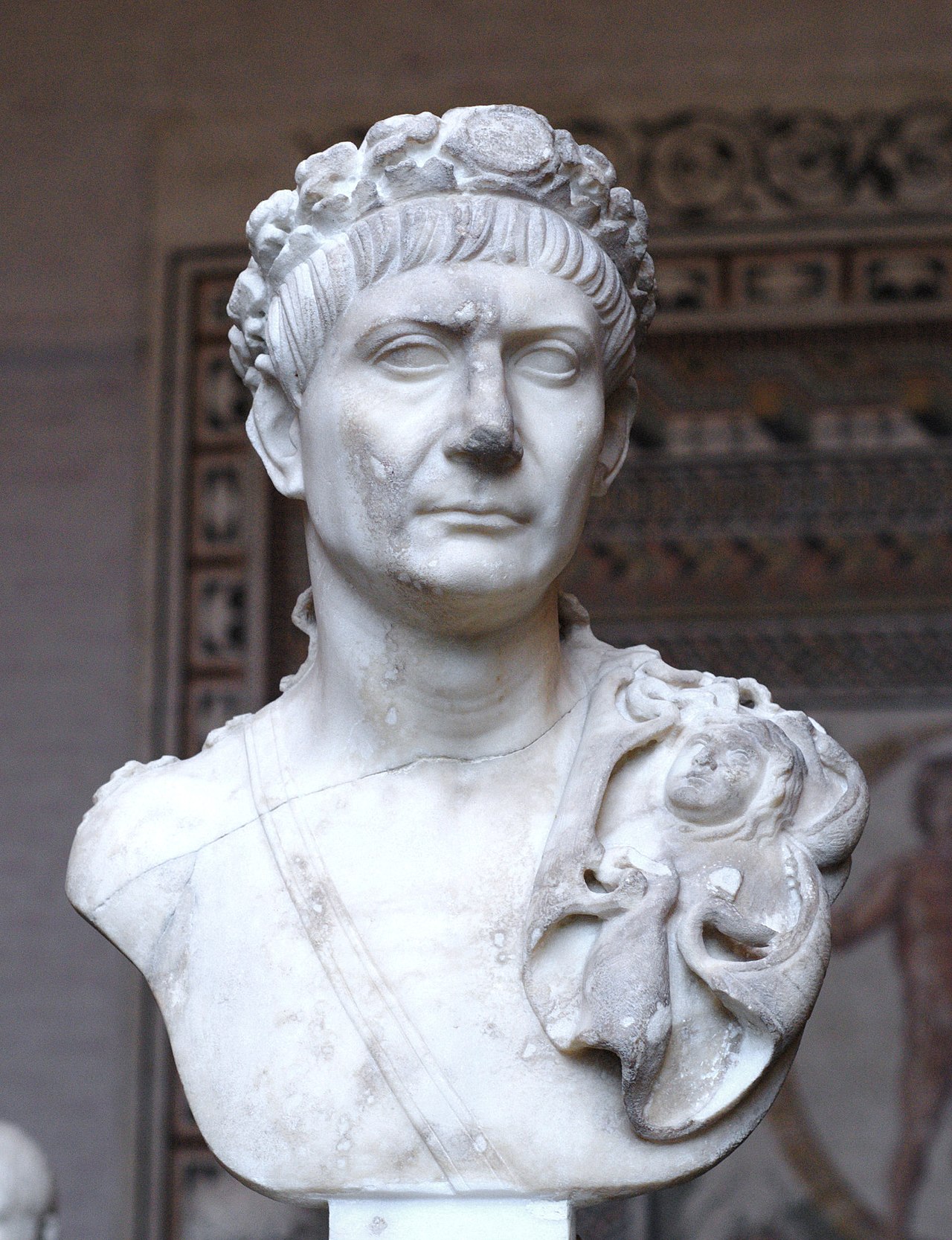
Roman Empire Reaches Greatest Territorial Extent Under Trajan
Rome reached its greatest territorial extent under Emperor Trajan, encompassing approximately 5 million km². The traditional population estimate of the empire accounted for between one-sixth and one-fourth of the world's total population. Trajan's expansionist policies represented the peak of Roman imperial power before a period of increasing consolidation and eventual decline.
File:Traianus Glyptothek Munich 72.jpg
Bust of Emperor Trajan, under whom the Roman Empire reached its greatest territorial extent
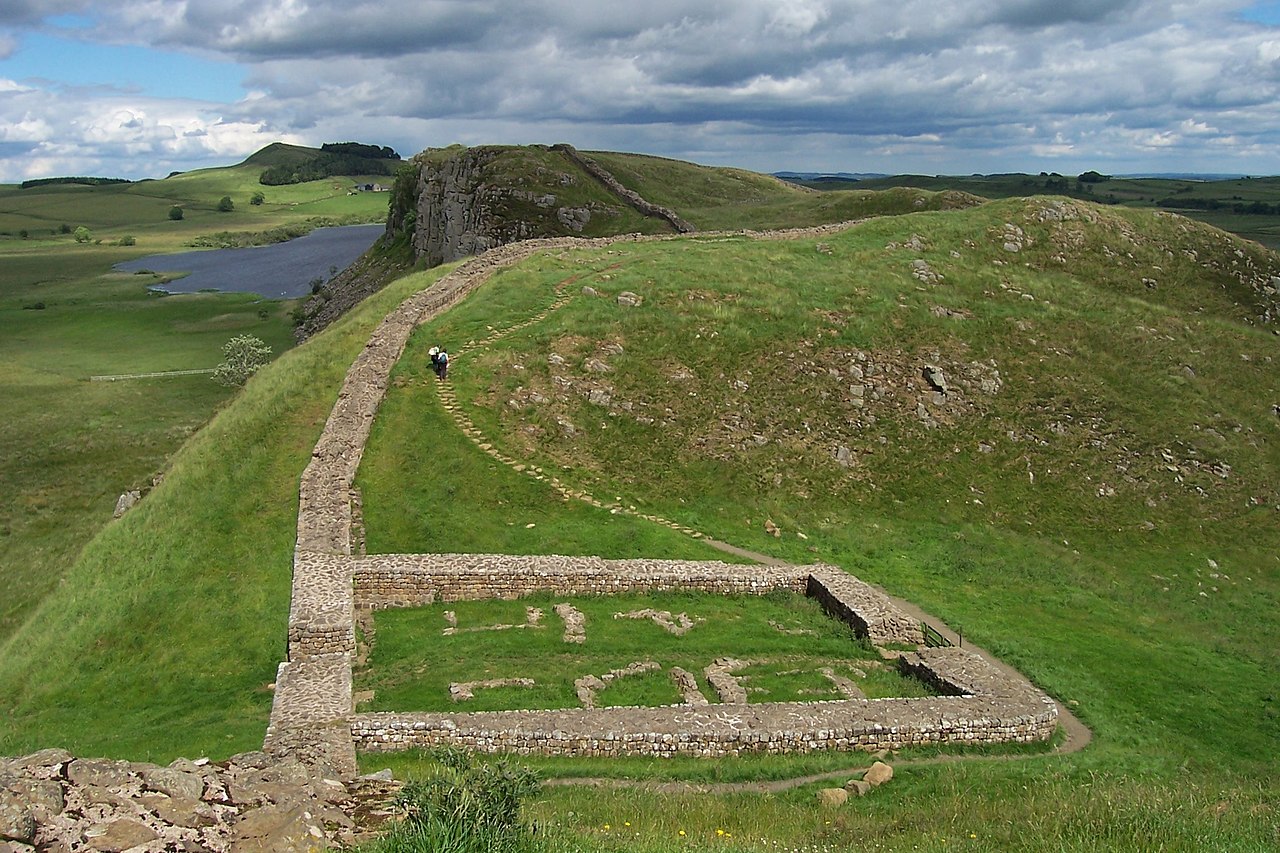
Hadrian's Wall Constructed
Emperor Hadrian adopted a policy of maintaining rather than expanding the empire, and Hadrian's Wall was constructed to separate the Roman world from what was perceived as an ever-present barbarian threat in northern Britain. It is the primary surviving monument of Rome's frontier defense efforts. The wall represents the shift from expansionist to consolidationist imperial policy.
File:Milecastle 39 on Hadrian's Wall.jpg
A segment of the ruins of Hadrian's Wall in northern England, overlooking Crag Lough
Hadrian Visits Judaea and Refounds Jerusalem
Emperor Hadrian visited the region of Judaea in 129/130 AD and refounded Jerusalem as the Roman colony Aelia Capitolina, naming it after his family and the Capitoline Triad. The refoundation overlaid the destroyed Jewish city with a new Roman urban plan and included the construction of a Temple to Jupiter on the site of the former Jewish Temple. These measures, combined with restrictions on Jewish practices, helped spark the Bar Kokhba Revolt.

File:Bust Hadrian Musei Capitolini MC817.jpg
Bust of Emperor Hadrian, who refounded Jerusalem as Aelia Capitolina
Bar Kokhba Revolt
Hadrian's measures in Judaea, combined with restrictions on Jewish practices, helped spark the Bar Kokhba Revolt from 132 to 135 AD. After crushing the uprising, Roman forces expelled most Jews from Jerusalem, barring their entry except on certain days. This revolt was the last major Jewish uprising against Roman rule and resulted in the near-complete dispersal of the Jewish population from Judaea.
Reign of Marcus Aurelius and the Five Good Emperors
The Nerva-Antonine dynasty produced the 'Five Good Emperors': Nerva, Trajan, Hadrian, Antoninus Pius, and Marcus Aurelius, representing a period of stable and effective governance. Marcus Aurelius was the last of these emperors, and his reign is often considered the end of the Pax Romana. Only two of his fourteen children are known to have reached adulthood, illustrating the harsh realities of ancient life even for the elite.

File:(Toulouse) Buste cuirassé de Marc Aurèle agè - Musée Saint-Raymond Ra 61 b.jpg
Bust of Marcus Aurelius, the last of the Five Good Emperors
Accession of Commodus Marks Beginning of Decline
In 180 AD, the accession of Commodus marked what Greek historian Cassius Dio described as the descent 'from a kingdom of gold to one of rust and iron.' This comment led historians, notably Edward Gibbon, to take Commodus's reign as the beginning of the Empire's decline. The period of unprecedented stability and prosperity known as the Pax Romana effectively ended.
3rd Century
Constitutio Antoniniana Grants Universal Citizenship
In 212 AD, during the reign of Caracalla, Roman citizenship was granted to all freeborn inhabitants of the empire through the Constitutio Antoniniana. This legal egalitarianism required a far-reaching revision of existing laws that distinguished between citizens and non-citizens. The extension of citizenship also seemed to increase the competitive urge among the upper classes to have their superiority affirmed within the justice system.
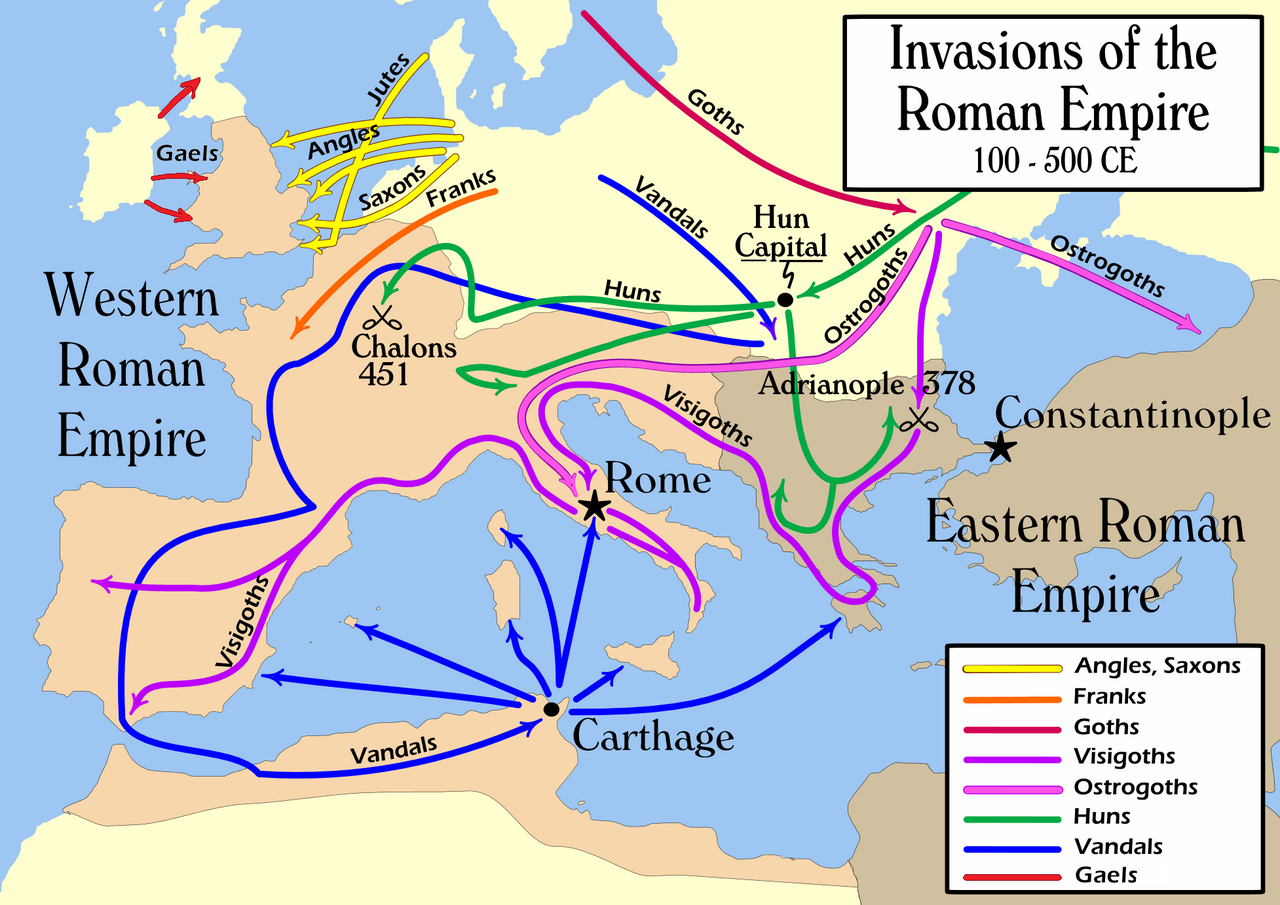
Crisis of the Third Century
The Empire was engulfed by the Crisis of the Third Century, a 49-year period of invasions, civil strife, economic disorder, and plague that threatened its very existence. The Gallic and Palmyrene empires broke away from the state, and a series of short-lived emperors led the Empire. This crisis sometimes marks the transition from classical to late antiquity in historical periodization.
File:Invasions of the Roman Empire 1.png
Map of barbarian invasions that contributed to the Crisis of the Third Century
Aurelian Reunifies the Empire
Emperor Aurelian stabilized the empire militarily and reunified it after the breakaway of the Gallic and Palmyrene empires during the Crisis of the Third Century. His reign also saw general economic anxieties come to a head, with bankers losing confidence in coins despite Roman coinage having long been fiat money. Aurelian's military successes earned him the title 'Restorer of the World'.
Diocletian Reorganizes the Empire and Establishes the Tetrarchy
Diocletian reorganized and restored much of the empire in 285 AD, dividing it into four regions each ruled by a separate tetrarch in what became known as the Tetrarchy. His reign also brought the empire's most concerted effort against Christianity, known as the 'Great Persecution.' Diocletian's efforts to stabilize the Empire after the Crisis of the Third Century included two major compilations of law, the Codex Gregorianus and the Codex Hermogenianus.
4th Century
Diocletian's Great Persecution of Christians
From 303 to 311 AD, Diocletian undertook the most severe persecution of Christians in Roman history, known as the 'Great Persecution.' This represented the empire's most concerted effort against the perceived threat of Christianity. The persecution ultimately failed to suppress Christianity and may have strengthened Christian resolve and identity.
Constantine the Great Converts to Christianity
In the early 4th century, Constantine I became the first emperor to convert to Christianity, fundamentally transforming the relationship between the Roman state and the Christian religion. He supported the Church financially and made laws that favored it, though he never engaged in a purge of non-Christians. The new religion had already grown from less than 50,000 to over a million adherents between 150 and 250 AD.
Constantine Moves Imperial Seat to Constantinople
Constantine the Great moved the imperial seat from Rome to Byzantium in 330 AD and renamed it Constantinople. This decision shifted the center of imperial power to the east and established Constantinople as the new capital of the Eastern Empire. The city would remain the capital of the Byzantine Empire for over a thousand years.
Emperor Julian Attempts to Restore Traditional Religion
Emperor Julian, under the influence of his adviser Mardonius, attempted to restore Classical Roman and Hellenistic religion, only briefly interrupting the succession of Christian emperors. He banned Christians from teaching the classical curriculum and tried to revive traditional public sacrifice. Julian met Christian resistance and lack of popular support, and his reign was short-lived.
Theodosius I Makes Christianity the State Religion
Theodosius I, the last emperor to rule over both East and West, made Christianity the state religion before his death in 395 AD. He made multiple laws and acted against alternate forms of Christianity, and heretics were persecuted and killed by both the government and the church throughout late antiquity. This decision permanently transformed the religious character of the Roman Empire and its successors.
Roman Empire Divided into Eastern and Western Halves
During the decades of the Constantinian and Valentinian dynasties, the empire was divided along an east-west axis, with dual power centres in Constantinople and Rome. Theodosius I, the last emperor to rule over both East and West, died in 395 AD after making Christianity the state religion. After his death, the empire was permanently divided between his two sons.

File:The Roman Empire, AD 395.png
The administrative divisions of the Roman Empire in 395 AD
5th Century
Western Roman Empire Begins to Disintegrate
The Western Roman Empire began to disintegrate in the early 5th century as Germanic peoples of dubious loyalty to Rome caused the empire to start dismembering itself. The Romans fought off all invaders, most famously Attila the Hun, but could not maintain cohesion. The Migration Period, involving large invasions by Germanic peoples and by the Huns of Attila, led to the accelerating decline of the Western Roman Empire.
File:Invasions of the Roman Empire 1.png
Map of barbarian invasions that led to the fall of the Western Roman Empire
Fall of the Western Roman Empire
With the fall of Ravenna to the Germanic Herulians and the deposition of Romulus Augustus in 476 by Odoacer, the Western Empire finally collapsed. Odoacer ended the Western Empire by declaring Zeno sole emperor and placing himself as Zeno's nominal subordinate, while in reality ruling Italy alone. Most chronologies place the end of the Western Roman Empire in this year, marking the transition from antiquity to the Middle Ages.

File:Western and Eastern Roman Empires 476AD(3).svg
The Roman Empire by 476, noting western and eastern divisions at the time of the Western Empire's fall
6th Century
Nika Riots in Constantinople
The Nika riots of 532 were one of the most violent riots in the history of Constantinople, demonstrating how spectacles could quickly become sites of social and political protest. Emperors sometimes had to deploy force to put down crowd unrest, most notoriously at this event. The riots resulted in the deaths of tens of thousands and nearly toppled Emperor Justinian.
9th Century
Charlemagne Crowned as Roman Emperor
The Holy Roman Empire was established in 800 when Pope Leo III crowned Charlemagne as Roman emperor, claiming succession to the Roman imperial tradition in the West. This event represented one of several attempts by medieval states to claim the legacy of the Roman Empire. In the medieval West, 'Roman' came to mean the church and the Catholic Pope.
15th Century
Fall of Constantinople and End of the Byzantine Empire
The Byzantine (Eastern Roman) Empire survived for over a millennium after the fall of the Western Empire, until the city of Constantinople fell in 1453. Constantine XI Palaiologos, the last Roman emperor, died in battle against Mehmed II and his Ottoman forces during the siege of Constantinople. Mehmed II adopted the title of caesar in an attempt to claim a connection to the former Empire, and his claim was recognized by the Patriarchate of Constantinople.