
A Man on the Moon
The Apollo 11 Moon landing represents the defining achievement of the Space Race and the culmination of the US-Soviet competition in space exploration.
Space Race
The Space Race was a 20th-century competition between the United States and the Soviet Union to achieve superior spaceflight capability, originating from Cold War tensions and the nuclear arms race following World War II. It encompassed pioneering achievements including the first artificial satellites, first humans in space, first Moon landing, and early robotic exploration of other planets. The competition gradually transitioned into cooperation, culminating in the Apollo-Soyuz mission of 1975 and later joint programs.
Source: Wikipedia1920 CE – 1924 CE
Soviet Gas Dynamics Laboratory Founded
The Soviet military sanctioned the Gas Dynamics Laboratory in 1921, a small research laboratory to explore solid-fuel rockets, led by Nikolai Tikhomirov. This marked the first Soviet development of artillery rockets and laid the groundwork for future Soviet rocketry programs.
1925 CE – 1929 CE
First Soviet Solid Fuel Rocket Test
The first test-firing of a solid fuel rocket was carried out in 1928 by the Soviet Gas Dynamics Laboratory. This represented an early milestone in Soviet rocketry development that would eventually lead to the space program.
1930 CE – 1934 CE
GIRD-X: First Soviet Liquid-Fueled Rocket
Soviet rocket pioneers Sergey Korolev, Friedrich Zander, Mikhail Tikhonravov, and Leonid Dushkin launched GIRD-X, the first Soviet liquid-fueled rocket, in 1933. This was a critical step in Soviet rocket development, and the same year the two design bureaus were combined into the Reactive Scientific Research Institute.
1945 CE – 1949 CE
Albert II: First Mammal in Space
Albert II, a rhesus monkey, was launched by the United States on a sub-orbital flight on June 14, 1949, becoming the first mammal in space. Unfortunately, he died on landing due to a parachute malfunction. This mission was part of early US efforts to understand the safety of the space environment before sending humans.
1950 CE – 1954 CE
R-1 Missile Enters Soviet Service
The R-1, a Soviet copy of the German A-4 (V-2) rocket, entered service in the Soviet Army on November 28, 1950. Chief designer Sergei Korolev oversaw the R-1's development, and the experience gained from assembling and launching A-4 rockets was directly applied to this project.
Tikhonravov Publishes 'Flight to the Moon'
Soviet rocketry engineer Mikhail Tikhonravov published 'Flight to the Moon' in the newspaper Pionerskaya pravda in October 1951, sparking public interest in space travel. He described a two-person interplanetary spaceship and forecast that Tsiolkovsky's dream would be realized within 10 to 15 years.
Collier's Magazine 'Man Will Conquer Space Soon!' Series
From March 1952 to April 1954, US Collier's magazine published a series of seven articles titled 'Man Will Conquer Space Soon!' detailing Wernher von Braun's plans for crewed spaceflight. This series helped build American public enthusiasm for space exploration.
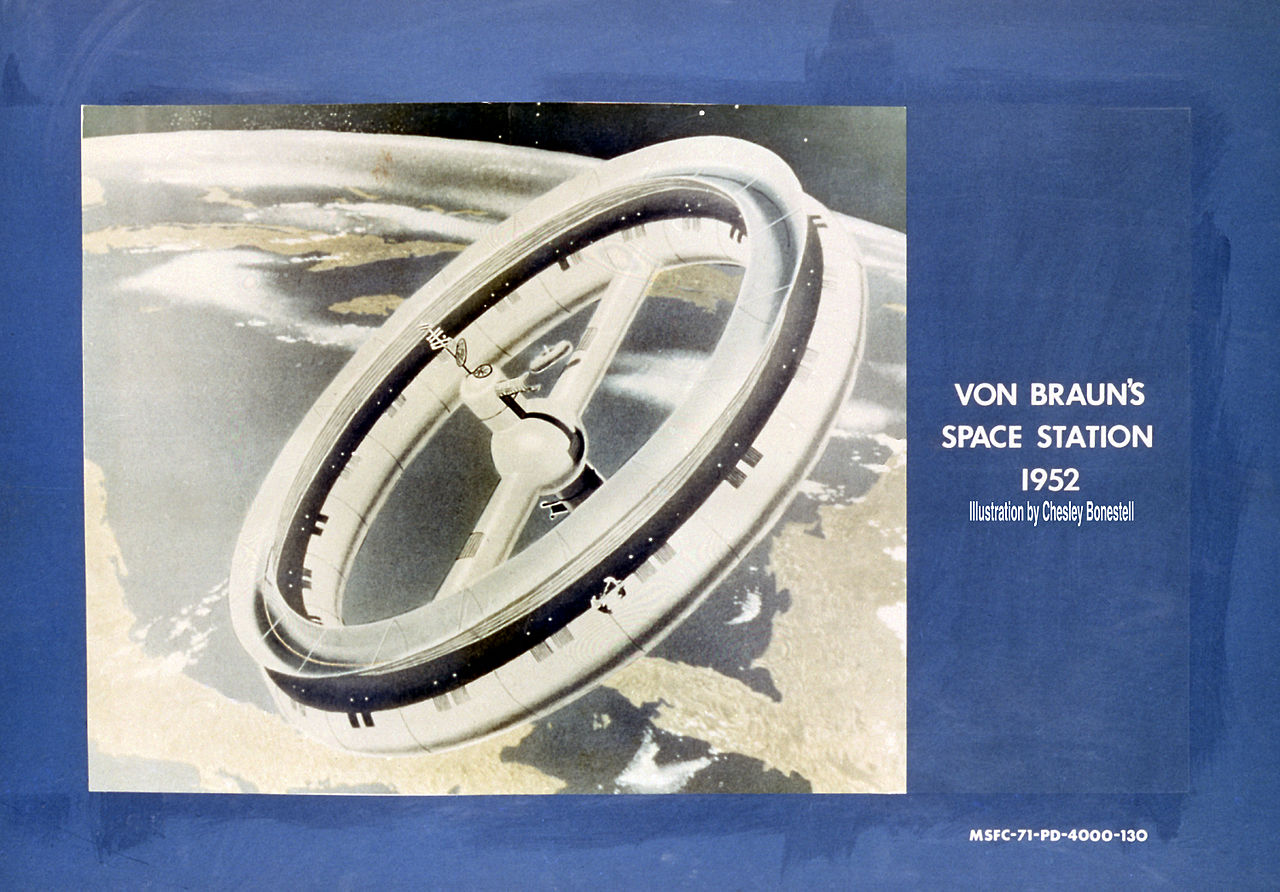
Von Braun 1952 Space Station Concept
Wernher von Braun's space station concept from 1952, which was featured in the Collier's magazine series
1955 CE – 1959 CE
Disney's 'Man in Space' Broadcast
In March 1955, Disneyland's animated episode 'Man in Space' was broadcast on US television with an audience of about 40 million people. The broadcast fired public enthusiasm for space travel and raised government interest in both the US and USSR.

The Challenges of Outer Space (1955)
Wernher von Braun presenting space exploration concepts in 1955
US Announces Intent to Launch Artificial Satellites
On July 29, 1955, James C. Hagerty, President Eisenhower's press secretary, announced that the United States intended to launch 'small Earth circling satellites' between July 1, 1957, and December 31, 1958, as part of the US contribution to the International Geophysical Year. This announcement effectively started the Space Race.
Soviet Union Announces Intent to Launch Satellite
On August 2, 1955, at the Sixth Congress of the International Astronautical Federation in Copenhagen, scientist Leonid I. Sedov told international reporters of the Soviet Union's intention to launch a satellite 'in the near future.' This was a direct response to the US announcement five days earlier.
Korolev Convinces Soviet Academy to Pursue Satellite
On August 30, 1955, Sergei Korolev succeeded in convincing the Soviet Academy of Sciences to establish a commission dedicated to achieving the goal of launching a satellite into Earth orbit before the United States. This can be viewed as the de facto start date of the Space Race.
R-7 Semyorka: World's First ICBM
On August 21, 1957, the R-7 flew its full range and became the world's first intercontinental ballistic missile. The R-7 was designed with a two-stage configuration and four boosters, and its development represented a major strategic milestone in the Cold War arms race.

R-7 Semyorka ICBM
The R-7 Semyorka, the world's first ICBM and the basis for Soviet space launch vehicles
Sputnik 1: First Artificial Satellite
On October 4, 1957, the Soviet Union launched Sputnik 1, the world's first artificial satellite, using a modified R-7 rocket. The small, beeping ball less than two feet in diameter shocked the Western world and triggered the 'Sputnik crisis,' demonstrating Soviet technological capability and raising fears about Soviet ICBM capability.

Sputnik 1
Sputnik 1, the world's first artificial satellite launched by the Soviet Union
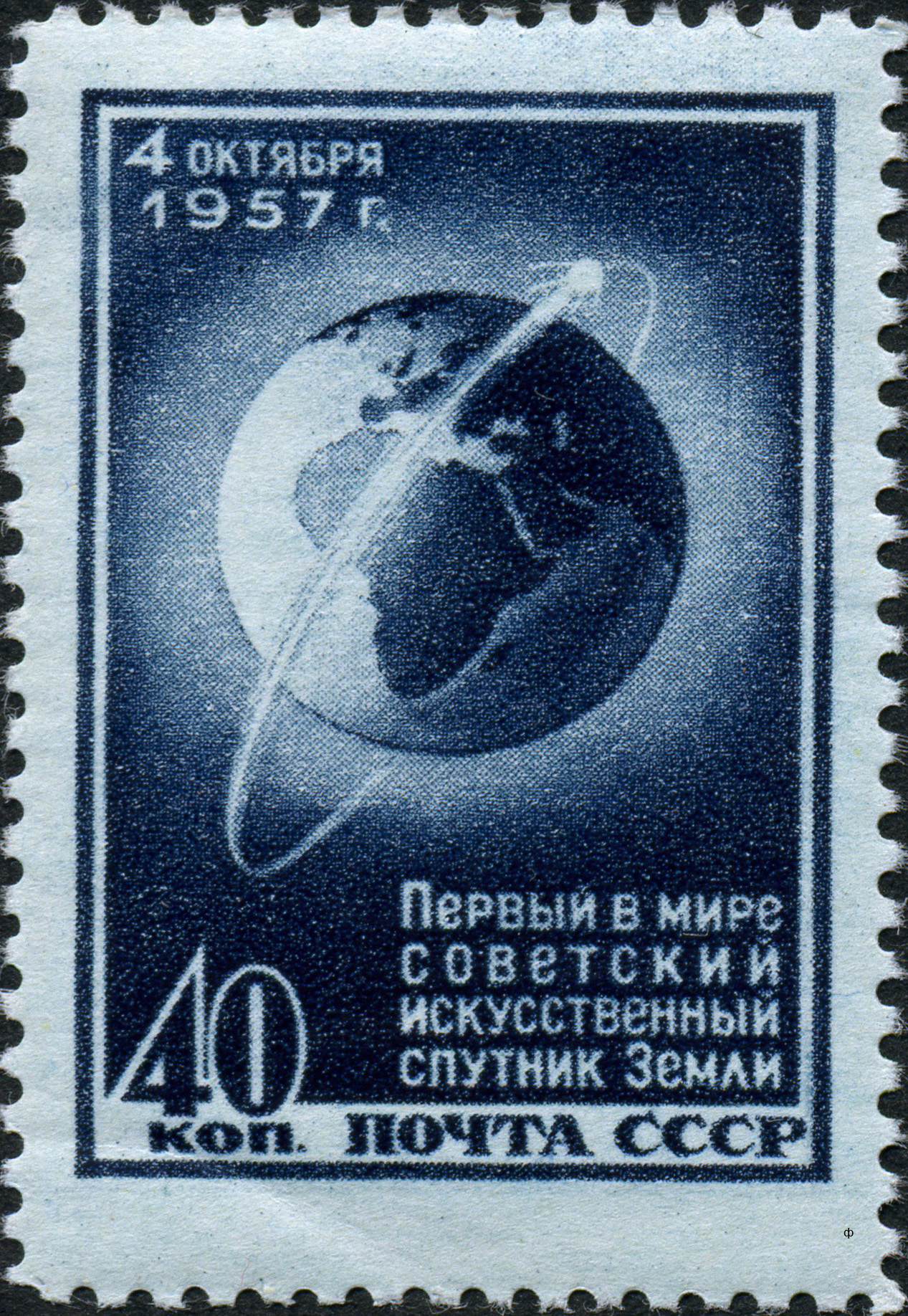
Soviet stamp commemorating Sputnik 1
Soviet commemorative stamp for Sputnik 1, 1957
Universal Newsreel Reports on Sputnik
On October 7, 1957, Universal Newsreel broadcast one of the first reports on Sputnik 1 to American audiences. The launch had caused widespread concern in the United States about Soviet technological superiority and national security.

Universal Newsreel on Sputnik 1
One of the first reports of Sputnik 1 by Universal Newsreel on October 7, 1957
Sputnik 2 Carries Laika into Orbit
On November 3, 1957, the Soviet Union launched Sputnik 2, carrying the dog Laika into orbit — the first animal to orbit Earth. The satellite weighed more than 500 kg, proving Soviet rocket superiority. Laika died during the mission; the true cause of death (stress and overheating) was not revealed until 2002.

Laika on a Romanian post stamp
Commemorative stamp featuring Laika, the first animal to orbit Earth
Project Vanguard Launch Failure
On December 6, 1957, the US Project Vanguard rocket exploded a few seconds after launch at Cape Canaveral, becoming an international embarrassment. The satellite appeared in newspapers under mocking names like 'Flopnik' and 'Kaputnik,' and the Soviet delegate at the UN offered the US aid 'under the Soviet program of technical assistance to backwards nations.'
Explorer 1: First US Satellite
On January 31, 1958, the United States successfully launched Explorer 1, its first satellite, on a Juno I rocket derived from the Army's Redstone missile. The satellite discovered the Van Allen radiation belt, a doughnut-shaped zone of high-level radiation intensity around the Earth, named after scientist James Van Allen who designed the satellite's instrumentation.

Explorer 1 team
William Hayward Pickering, James Van Allen, and von Braun display a model of Explorer 1 at a news conference
Eisenhower Recommends Creation of NASA
On April 2, 1958, President Eisenhower recommended to Congress that a civilian agency be established to direct nonmilitary space activities, in response to the Soviet space lead. Congress passed the National Aeronautics and Space Act, which Eisenhower signed into law on July 29, 1958, creating NASA from the National Advisory Committee on Aeronautics.
NASA Officially Established
On July 29, 1958, President Eisenhower signed the National Aeronautics and Space Act into law, officially creating NASA. The law transformed the National Advisory Committee on Aeronautics into the National Aeronautics and Space Administration and also created a Civilian-Military Liaison Committee to coordinate civilian and military space programs.
Luna 1: First Spacecraft to Reach Lunar Vicinity
On January 2, 1959, the Soviet Union successfully launched Luna 1, which became the first spacecraft to reach the vicinity of the Moon, though it missed the Moon itself. This was the fourth attempt in the Luna program, following three failed secret 1958 attempts.
Luna 2 Impacts the Moon
On September 14, 1959, Luna 2 successfully impacted the Moon, becoming the first man-made object to reach the lunar surface. This was a significant Soviet achievement in the Space Race, demonstrating their ability to precisely target the Moon.
Luna 3 Photographs Far Side of the Moon
On October 7, 1959, Luna 3 successfully flew by the Moon and sent back the first pictures of its far side, which had never been seen by humans before. This was a major scientific and propaganda achievement for the Soviet Union.
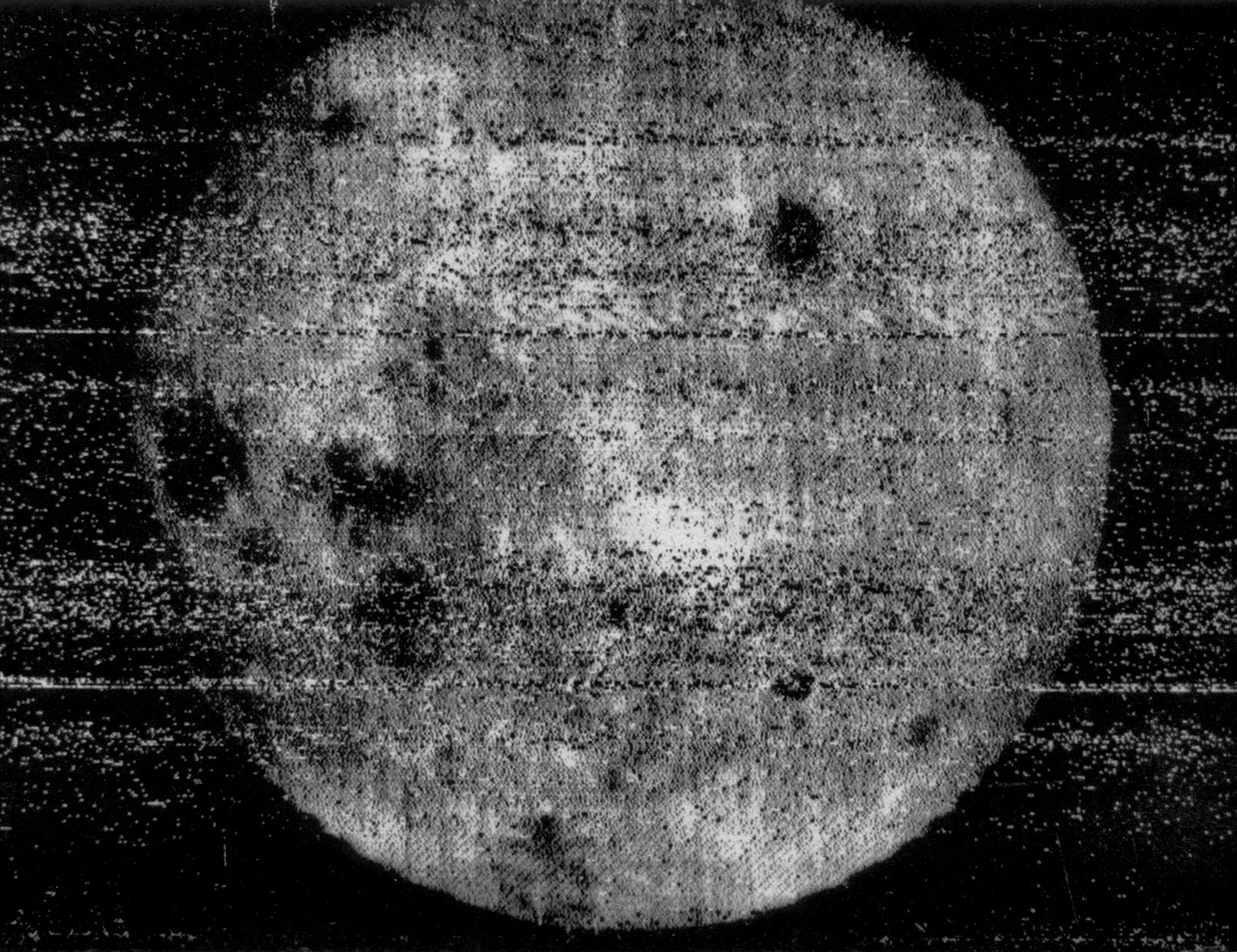
First photo of the far side of the Moon
The first photo of the far side of the Moon, taken by Luna 3 in 1959
1960 CE – 1964 CE
Vostok 1: Yuri Gagarin Becomes First Human in Space
On April 12, 1961, the USSR launched Yuri Gagarin into a single 108-minute orbit around the Earth in Vostok 1, making him the first human in space. Gagarin became a worldwide celebrity and national hero, and April 12 was declared Cosmonautics Day in the USSR. The flight shocked the US and intensified the Space Race.

Gagarin and Vostok 1 stamp
A 1964 Soviet stamp featuring Yuri Gagarin and an intentionally inaccurate Vostok spacecraft

Vostok spacecraft replica
Replica of the Vostok spacecraft that carried Gagarin into orbit
Alan Shepard: First American in Space
On May 5, 1961, Alan Shepard became the first American in space, launching in a ballistic trajectory on Mercury-Redstone 3 in a spacecraft he named Freedom 7. Though he did not achieve orbit like Gagarin, he was the first person to exercise manual control over his spacecraft's attitude and retro-rocket firing.

Alan Shepard during Mercury-Redstone 3
Alan Shepard, the first American in space, during the Mercury-Redstone 3 mission in 1961
Kennedy Commits US to Moon Landing
On May 25, 1961, President Kennedy asked Congress to commit to the goal of 'landing a man on the Moon and returning him safely to the Earth' before the end of the decade. This speech, titled 'Special Message on Urgent National Needs,' was a direct response to Gagarin's flight and the Bay of Pigs embarrassment, dramatically escalating the Space Race.
Gus Grissom's Suborbital Flight
On July 21, 1961, Virgil 'Gus' Grissom repeated Shepard's suborbital flight in Liberty Bell 7, becoming the second American in space. The mission was largely successful, though the spacecraft sank after splashdown when the hatch blew prematurely.

Mercury capsule cutaway
Cutaway diagram of the Mercury capsule used in early US human spaceflight missions
Starfish Prime Nuclear Test in Space
The United States conducted the Starfish Prime nuclear test, detonating a nuclear bomb in outer space. This test led to the signing of the Partial Nuclear Test Ban Treaty in 1963 by more than 100 signatories, including both the United States and the Soviet Union.

Starfish Prime debris fireball
The debris fireball of Starfish Prime nuclear test in space seen from Honolulu
John Glenn Orbits Earth
On February 20, 1962, astronaut John Glenn became the first American to orbit the Earth, completing three orbits in the Friendship 7 spacecraft. His Mercury-Atlas 6 mission splashed down safely in the Atlantic Ocean after a tense reentry due to what falsely appeared to be a loose heat shield. Glenn became a national hero and received a ticker-tape parade in New York City.
Vostok 3 and 4 Dual Launch
On August 11 and 12, 1962, the USSR launched two piloted spacecraft, Vostok 3 and Vostok 4, in essentially identical orbits, demonstrating 24-hour launch pad turnaround. The two spacecraft came within approximately 5 km of one another, close enough for radio communication, and Vostok 4 set a record of nearly four days in space.
Kennedy's 'We Choose to Go to the Moon' Speech
On September 12, 1962, President Kennedy rallied popular support for the Apollo program in his 'We choose to go to the Moon' speech before a large crowd at Rice University Stadium in Houston, Texas. The speech articulated the national commitment to lunar exploration and remains one of the most famous speeches in American history.
Mariner 2: First Successful Interplanetary Spacecraft
In December 1962, Mariner 2 became the first man-made object to fly by another planet when it passed by Venus. Mariner 1 had failed shortly after launch, but Mariner 2 successfully conducted the first interplanetary flyby, marking a major milestone in space exploration.

Mariner 2
Artist's impression of Mariner 2, the first successful interplanetary spacecraft
Valentina Tereshkova: First Woman in Space
On June 16, 1963, Valentina Tereshkova was launched into space on Vostok 6, becoming the first woman in space. She was chosen from a small group of female parachutist factory workers, and her flight was possibly a medical experiment. She remains the only woman to have flown a solo space mission.
Kennedy Proposes Joint US-USSR Moon Mission
On September 20, 1963, President Kennedy proposed before the United Nations General Assembly that the United States and Soviet Union join forces in an effort to reach the Moon. This represented a significant shift in Kennedy's thinking about the Space Race, preferring cooperation over competition to ease Cold War tensions.
Kennedy Assassinated
On November 22, 1963, President Kennedy was assassinated, ending his presidency and his proposals for a joint US-Soviet Moon mission. Khrushchev's son later claimed that Khrushchev had been poised to accept Kennedy's joint Moon mission proposal at the time of the assassination.
Mariner 4: First Successful Mars Flyby
In 1964, NASA's Mariner 4 became the first spacecraft to successfully fly by Mars, transmitting 21 pictures of the planet's surface. This was a major achievement in planetary exploration, providing the first close-up images of another planet.
Soviet Lunar Program Officially Established
On August 3, 1964, the Soviet lunar program was officially established with the adoption of Soviet Communist Party Central Committee Command 655-268. The decree directed Vladimir Chelomei to develop a Moon flyby program and Korolev to develop the Moon landing program, with circumlunar flights planned for 1967 and landings starting in 1968.

Soviet LK and American Apollo Lunar Module
Comparison of Soviet LK and American Apollo Lunar Module lunar landers
Voskhod 1: First Multi-Person Spaceflight
On October 12, 1964, Voskhod 1 became the first spaceflight with a three-person crew, beating the US Gemini program. The USSR touted this as a technological achievement, though the cosmonauts flew without spacesuits due to the craft's limited cabin space, exposing them to significant risk.

Vostok and Voskhod crew seating
Diagram showing how Korolev modified the one-person Vostok capsule to carry three people for Voskhod
Khrushchev Deposed
On October 16, 1964, Leonid Brezhnev and a small cadre of high-ranking Communist Party officials deposed Khrushchev as Soviet government leader, one day after Voskhod 1 landed. The new political leaders ended the technologically troublesome Voskhod program and started concentrating on reaching the Moon.
1965 CE – 1969 CE
Gemini Program Begins
Project Gemini began its crewed missions in March 1965, with ten crewed missions between March 1965 and November 1966. The program developed key technologies including space rendezvous and docking, extended flight durations, and extravehicular activity, all necessary for the Apollo Moon landing program.

Gemini 6 and 7 rendezvous
Rendezvous of Gemini 6 and 7 in December 1965, demonstrating key space rendezvous technology
Alexei Leonov Performs First Spacewalk
On March 18, 1965, the USSR launched Voskhod 2 with Pavel Belyayev and Alexei Leonov, who performed the first-ever extravehicular activity (EVA). Leonov's spacesuit expanded in the vacuum of space, nearly preventing him from re-entering the airlock, and he had to partially depressurize his suit to a potentially dangerous level to return safely.
Luna 9: First Soft Landing on the Moon
In 1966, Luna 9 achieved the first soft-landing on the Moon and successfully transmitted photography from the surface. This was a major Soviet achievement, providing the first images from the lunar surface and demonstrating that the Moon's surface could support a spacecraft.

First photo of the surface of the Moon
First photo of the surface of the Moon, taken by Luna 9 in 1966
Korolev Dies
Sergei Korolev, the chief designer of the Soviet space program, died on January 14, 1966. His death was a major blow to the Soviet space program; Voskhod 2 had been his final achievement, and according to historian Asif Siddiqi, his accomplishments marked 'the absolute zenith of the Soviet space program, one never, ever attained since.'
Venera 3 Impacts Venus
On March 1, 1966, Venera 3 became the first man-made object to make contact with another planet when it impacted Venus. Despite operational difficulties resulting in loss of contact with the craft, this was a significant milestone in planetary exploration.
Outer Space Treaty Signed
On January 27, 1967, the United States, the USSR, and the United Kingdom signed the Treaty on Principles Governing the Activities of States in the Exploration and Use of Outer Space. The treaty bars weapons of mass destruction in space, limits the Moon and celestial bodies to peaceful purposes, and declares space exploration shall benefit all countries.
Apollo 1 Fire Kills Three Astronauts
On January 27, 1967, the crew of the first crewed Apollo mission — Gus Grissom, Ed White, and Roger Chaffee — were killed in a fire that swept through their spacecraft cabin during a ground test. The fire was caused by an electrical spark in the spacecraft's pure oxygen atmosphere, and the crew could not escape due to the plug door hatch design.

Apollo 1 fire
Charred interior of the Apollo 1 spacecraft after the fire that killed the crew
Surveyor 3 Lands on Moon, Tests Lunar Soil
Surveyor 3 successfully touched down on the Moon on April 20, 1967, and carried a 'surface sampler' which facilitated tests of the lunar soil. Scientists concluded that lunar soil had a consistency similar to wet sand with sufficient bearing strength to support an Apollo Lunar Module. The Surveyor 3 lander would later be visited by Apollo 12 astronauts.

Moon landing map
Map showing Luna probe landing locations, Surveyor landings, and Apollo landings on the Moon
Soyuz 1 Crash: First In-Flight Spaceflight Fatality
On April 24, 1967, Vladimir Komarov became the first in-flight spaceflight fatality when Soyuz 1 crashed after its parachute system failed during reentry. The mission had been plagued with problems from the start, including a solar panel failure and orientation detector issues, and the reserve parachute became tangled with the drogue chute.

Soyuz 1 crash
Soyuz 1 seen after the crash that killed Vladimir Komarov
Zond 5: First Circumlunar Flight with Living Creatures
In September 1968, Zond 5 made a circumlunar flight with tortoises on board and returned safely to Earth, accomplishing the first successful water landing of the Soviet space program in the Indian Ocean. The mission scared NASA planners, as it took them several days to figure out it was not a piloted flight because voice recordings were transmitted from the craft.

Soyuz 7K-L1 Zond spacecraft
Artist view of the Soyuz 7K-L1 Zond spacecraft used for circumlunar missions
Apollo 7: First Crewed Apollo Mission
On October 11, 1968, Apollo 7 was launched with Grissom's backup crew, accomplishing Apollo 1's original mission to check out the Apollo Command and Service Module in Earth orbit. The eleven-day mission was a total success, with the spacecraft performing a virtually flawless mission, paving the way for the lunar mission schedule.
Apollo 8: First Humans to Orbit the Moon
On December 21, 1968, Frank Borman, James Lovell, and William Anders became the first humans to leave low-Earth orbit and travel to another celestial body, entering lunar orbit on December 24. They made ten orbits in twenty hours and transmitted one of the most watched TV broadcasts in history, concluding with a reading from the Book of Genesis on Christmas Eve.

Earthrise from Apollo 8
Earthrise as seen from Apollo 8 on December 24, 1968, photographed by astronaut William Anders
Soyuz 4 and 5: First Docking of Two Crewed Spacecraft
In January 1969, the Soyuz 4 and Soyuz 5 missions achieved the first-ever docking of two crewed spacecraft and the first transfer of crew from one space vehicle to another. This was the completion of the mission originally planned for Soyuz 1 and 2.
N-1 Rocket Explosion on Launch Pad
On July 3, 1969, the Soviet N-1 rocket hit the launch pad after an engine shutdown, destroying itself and the launch facility in a catastrophic explosion. This was a significant setback for the Soviet crewed lunar program, as without the N-1 rocket, the USSR could not send a large enough payload to the Moon to land a human and return him safely.
Apollo 11: First Humans on the Moon
On July 20, 1969, Neil Armstrong and Buzz Aldrin became the first humans to land on the Moon, with Armstrong stepping onto the lunar surface at 02:56 UTC on July 21. The first step was witnessed on live television by at least one-fifth of Earth's population. Armstrong's words — 'That's one small step for [a] man, one giant leap for mankind' — became iconic.
A Man on the Moon
Astronaut on the lunar surface during the Apollo 11 mission

Buzz Aldrin and Apollo 11 Lunar Lander
Buzz Aldrin facing away from camera with the Apollo 11 Lunar Lander

The Eagle has landed newspaper
A girl reading a newspaper quoting the famous phrase 'The Eagle has landed'
Apollo 11 Returns to Earth
Apollo 11 left lunar orbit and returned to Earth, landing safely in the Pacific Ocean on July 24, 1969. When the spacecraft splashed down, 2,982 days had passed since Kennedy's commitment to landing a man on the Moon; the mission was completed with 161 days to spare. With this, the Americans won the race to the Moon.
Apollo 12: Precision Moon Landing
In November 1969, Apollo 12 made a precision landing on the Moon within walking distance of the Surveyor 3 spacecraft that had landed on April 20, 1967. This demonstrated the ability to land at a specific target on the lunar surface, a key capability for future missions.
1970 CE – 1974 CE
Luna 16: First Uncrewed Sample Return from Moon
In late 1970, Luna 16 was launched by the Soviet Union and became the first uncrewed probe to return a sample from the Moon. This demonstrated continued Soviet willingness to compete with the US in the space race despite having lost the manned Moon landing aspect.
Venera 7: First Data Returned from Another Planet's Surface
In 1970, the Soviet Union's Venera 7 marked the first time a spacecraft was able to return data after landing on another planet. The probe measured a surface temperature of 475°C and atmospheric pressure of 92 bar on Venus, providing the first direct measurements from another planet's surface.
Lunokhod 1: First Robotic Rover on the Moon
The Soviet Union successfully landed the first robotic rover on the Moon in 1970 with the Lunokhod 1 mission. This was followed by another rover in 1973, demonstrating continued Soviet capability in robotic lunar exploration.
Apollo 13 Aborts Lunar Landing
In April 1970, Apollo 13 had to abort its lunar landing due to an in-flight spacecraft failure when an oxygen tank exploded, but the crew was returned safely to Earth. This near-disaster demonstrated both the risks of space exploration and NASA's ability to improvise solutions under extreme pressure.
Mars 3: First Soft Landing on Mars
In 1971, the Soviet Mars 3 successfully landed on Mars, becoming the first spacecraft to achieve a soft landing on the Red Planet. However, the lander only transmitted data for 14.5 seconds before losing contact, limiting the scientific return of the mission.
Salyut 1: First Space Station Launched
On April 19, 1971, the Soviets launched Salyut 1, the world's first space station. The Soyuz 11 crew successfully docked on June 7 and completed a then-record 22-day stay, but tragically became the second in-flight space fatality during reentry on June 30 when they were asphyxiated due to cabin depressurization.
Apollo-Soyuz Agreement Signed
In April 1972, President Nixon and Soviet Premier Brezhnev negotiated an easing of relations known as détente, and the two nations planned a joint mission to dock the last US Apollo craft with a Soyuz. This agreement represented a significant shift from competition to cooperation in space.
Apollo Program Final Lunar Landing
The Apollo program made its final lunar landing in December 1972 with Apollo 17. In total, the Apollo program involved six crewed Moon landings from 1969 to 1972, and a total of twelve astronauts walked on the surface of the Moon.
Skylab Launched
On May 14, 1973, the United States launched Skylab, a single orbital workstation using a leftover Saturn V rocket from the Apollo program. Skylab was damaged during ascent, losing a solar panel and meteoroid thermal shield, but subsequent crewed missions repaired the station and conducted valuable research.

Skylab Orbital Workshop
Skylab Orbital Workshop as photographed by the Skylab 4 CSM during the final fly-around
N-1 Rocket Program Canceled
In May 1974, the Soviet Union finally canceled the N-1 rocket program after two more launch failures in 1971 and 1972, without achieving a single successful uncrewed test flight. This effectively ended Soviet ambitions for a crewed lunar landing.
1975 CE – 1979 CE
Venera 9: First Photos of Venus Surface
In 1975, Venera 9 established an orbit around Venus and successfully returned the first photography of the surface of Venus. Venera 10 followed shortly after with additional photography, providing the first visual data from the surface of another planet.
Apollo-Soyuz Test Project: First US-Soviet Space Docking
On July 15, 1975, Soyuz 19 was launched, followed by the Apollo craft six and a half hours later. The two craft rendezvoused and docked on July 17, with the three astronauts and two cosmonauts conducting joint experiments, shaking hands, exchanging gifts, and visiting each other's craft. This mission is considered by many as the final act of the Space Race.

Apollo-Soyuz handshake
American Stafford and Russian Leonov shake hands in space aboard the Apollo-Soyuz docking adapter
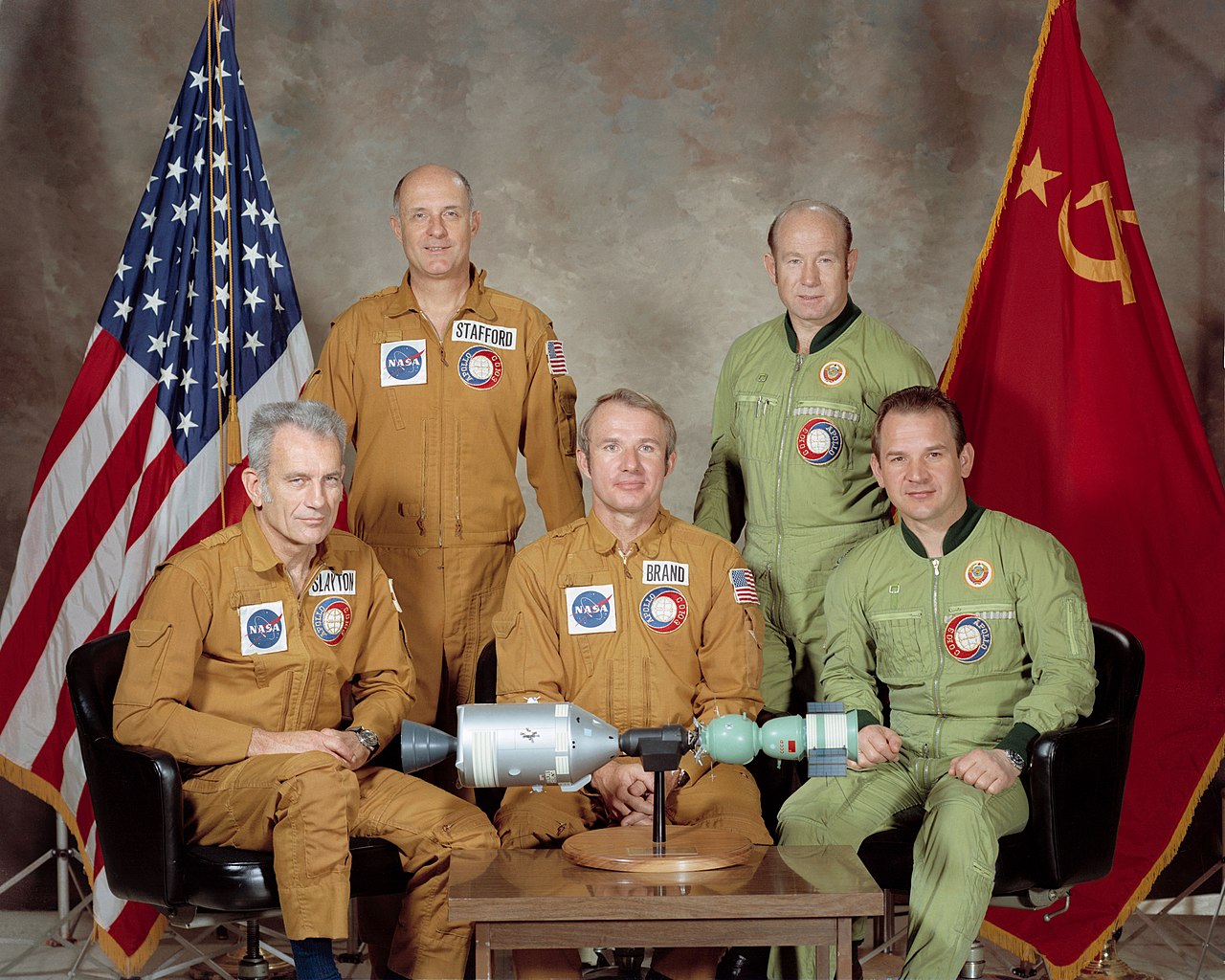
ASTP crews portrait
Portrait of the Apollo-Soyuz Test Project crews
Viking 1 and 2 Land on Mars
In 1976, NASA put two successful landers on Mars — Viking 1 and Viking 2. These significantly larger landers took the first photographs from the surface of Mars and conducted extensive scientific experiments. Viking 1 operated for around six years and Viking 2 for over three years.

Surface of Mars taken by Viking 1
Surface of Mars photographed by Viking 1
First Space Shuttle Approach and Landing Test
On August 12, 1977, NASA achieved the first approach and landing test of its Space Shuttle orbiter on a Boeing 747 carrier plane. This was a key milestone in the development of the reusable Space Shuttle system, which would become NASA's primary orbital vehicle.

Soyuz, Space Shuttle, and Energia-Buran comparison
Comparison of Soyuz, US Space Shuttle, and Soviet Energia-Buran spacecraft
1980 CE – 1984 CE
Venera 13: First Probe to Drill Another Planet
In 1981, Venera 13 performed a successful soft-landing on Venus and marked the first probe to drill into the surface of another planet and take a sample. It also took an audio sample of the Venusian environment and returned the first color images of the surface of Venus.
First Space Shuttle Orbital Flight
On April 12, 1981, the first orbital test flight of a complete, crewed Space Shuttle was launched, consisting of the orbiter, an external fuel tank, and two solid rocket boosters. The Space Shuttle represented a new era in reusable spacecraft, though the designers underestimated the time and cost of refurbishment between flights.
Space Shuttle comparison
Comparison of Soyuz, US Space Shuttle, and Soviet Energia-Buran spacecraft
Sally Ride: First American Woman in Space
In June 1983, Sally Ride became America's first woman in space on STS-7. NASA had not welcomed female astronauts into its corps until 1978, when six female mission specialists were recruited, nearly 20 years after the Soviet Union sent Valentina Tereshkova into space.
1985 CE – 1989 CE
Mir Space Station Assembly Begins
The USSR began assembling the modular space station Mir in orbit in 1986, with assembly continuing until 1996. Mir held records for the largest spacecraft and the longest continuous human presence in space at 3,644 days, until the International Space Station was built starting in 1998.

Atlantis docked to Mir
Space Shuttle Atlantis docked to the Mir space station
Energia-Buran First Orbital Flight
In November 1988, the Soviet Energia-Buran made its only orbital test flight. Unlike the US Shuttle, it could be flown pilotlessly and landed automatically. However, US counterintelligence had baited the Soviets with disinformation about the heat shield design, making it not reusable for repeated flight.
Energia-Buran comparison
Comparison of Soyuz, US Space Shuttle, and Soviet Energia-Buran spacecraft
1990 CE – 1994 CE
Soviet Union Collapses, Ending Space Race
The collapse of the Soviet Union in 1991 effectively ended the Space Race, with the Buran program canceled due to lack of funding. The assets of the USSR's space program passed mainly to Russia, and the Cold War competition in space was gradually replaced with cooperation between the US and the newly reconstituted Russian Federation.
Shuttle-Mir and ISS Programs Agreed
In 1993, the US and the newly reconstituted Russian Federation agreed on the Shuttle-Mir and International Space Station programs, formally ending their Cold War competition in space and beginning a new era of cooperation. This agreement built on the foundation laid by the Apollo-Soyuz mission.
Atlantis docked to Mir
Space Shuttle Atlantis docked to the Mir space station, representing US-Russian cooperation in space